
How Oregon Tool Found a Better Path to Prototyping
For a company like Oregon Tool, precision isn’t a preference. It’s an unconditional requirement. The Portland-based manufacturer produces cutting tools and steel components relied upon in demanding, high-performance applications, and the bar for both consistency and durability is set exceptionally high. So when their engineering teams wanted to explore new component geometries, they faced a familiar challenge for high-volume manufacturers: developing prototypes using traditional production processes is costly, time-consuming, and difficult to scale. Every new design iteration carries a significant price tag. Costs, as well as budgets and their cycles, often are barriers to pursuing innovation.
For an answer to that question, Oregon Tool turned to OMIC R&D.
To push through on its exploration, Oregon Tool began looking at Laser Powder Bed Fusion (LPBF) as a potential solution. LPBF technology builds fully dense metal parts, layer by layer, using a focused laser and powdered metal, offering the kind of geometric flexibility and dimensional accuracy that makes it extremely well-suited for metals prototyping. But LPBF also has limitations, especially when the end application demands parts with high hardness and tight geometric tolerances. When Oregon Tool began reaching out to print-on-demand service providers, they found that their requirements exceeded what most could deliver. The research question wasn’t just “can LPBF make this part?” Instead, it was “can LPBF make this part to our precise standard?”
A Research Partnership Built for Hard Problems
Working alongside Oregon Tool’s engineering team, OMIC R&D researchers designed a systematic investigation to determine whether LPBF could meet the company’s prototyping requirements. The team tested three different metal types, developing and refining LPBF printing parameters and heat treatment cycles highly specific to Oregon Tool’s target geometry and performance thresholds.
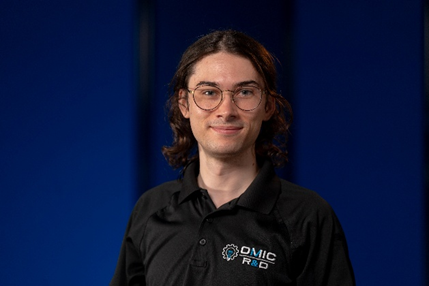
What makes OMIC R&D’s model distinctive is that its researchers are also its machine operators. Will Watts, Associate Additive Manufacturing Solutions Researcher, not only designed the investigation, but ran it, operating the Renishaw RenAM 500S Flex himself and remaining hands-on through every stage of production and analysis. That’s “applied” at a completely different level.
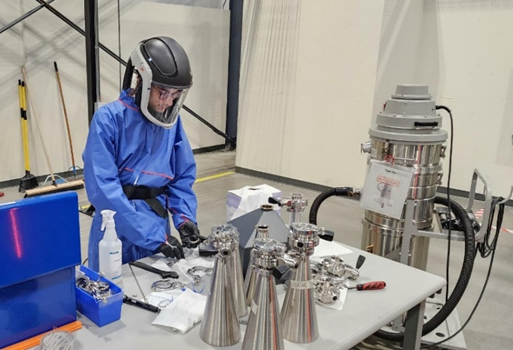
“In most R&D environments, there’s a clear separation between the researcher and the person running the equipment. That gap costs you information,” said Urmaze Naterwalla, Director of Research and Operations at OMIC R&D. “That’s a large part of what sets us apart from other institutions. On projects conducted at OMIC, those two jobs are conducted by the same person. Will isn’t handing off to a technician and waiting for results. He’s at the machine, making observations in real time, and feeding that directly back into the research. That level of integration is just one of the things about the work we do here that’s difficult to replicate elsewhere.”
Parts were produced on the Renishaw RenAM 500S Flex, equipped with a reduced build volume that allows for efficient material transfer between runs. Heat treatment was performed using OMIC R&D’s Elnik 3025T vacuum sintering furnace. Each material and parameter combination was then evaluated for hardness using the Struers Duramin-650, assessed for geometric accuracy using the ATOS 5 ScanBox 6130, and analyzed for surface finish with the MahrSurf PS10. Metallographic inspection was also performed to ensure that none of the high-hardness materials would be susceptible to cracking, which is a known failure mode for parts processed via LPBF at elevated hardness levels.
The OMIC R&D Difference
For many Oregon manufacturers, the barrier to applied research isn’t interest. It’s access. Engaging a university research department can be slow and administratively complex. Hiring external consultants can be expensive. And as Oregon Tool discovered firsthand, commercial print-on-demand services often lack the technical depth to tackle non-standard requirements.
OMIC R&D was built to leap all those barriers. As a research center hosted by Oregon Tech, Oregon’s only polytechnic university, OMIC R&D is uniquely positioned to offer the kind of applied, hands-on research that connects directly to manufacturing challenges. Oregon Tech’s polytechnic identity means the institution is oriented toward practical application by design, and that orientation extends fully to the work done at OMIC R&D’s Scappoose facility. It’s a model that is unique to the state, and rare at a national level.
“Oregon Tool came to us with a problem that required real research, not a catalog solution,” said Naterwalla. “What we’re able to offer is a combination that’s hard to find: advanced capital equipment, researchers who are expert operators, and a mission that is explicitly oriented toward helping Oregon manufacturers succeed. The goal isn’t to publish a paper. The goal is to solve the problem.”
OMIC R&D operates on a cost-accessible model, taking on member projects at cost in most cases. For Oregon Tool, the project carried no charge at all, made possible through OMIC R&D’s designation as a Center of Innovation Excellence by Business Oregon. The CIE program recognizes organizations that advance innovation and applied research in support of Oregon’s economy. OMIC R&D is one of only five designated centers statewide, alongside OTRADI, ONAMI, the Oregon UAS Accelerator, and the Silicon Forest Partnership. That designation reflects a commitment to making advanced manufacturing research accessible to Oregon companies who might not otherwise be able to pursue it.
“One of the things the CIE designation allows us to do is remove yet another barrier – cost,” said Naterwalla. “A project like this one with the equipment time, the metallographic analysis, the iterative parameter development, represents a real investment. The fact that Oregon Tool could access that capability without a financial obstacle is exactly what this program is designed to enable. We want every Oregon manufacturer to know that door is open to provide Oregon companies with a competitive edge.”
Results That Open Doors
The research delivered a clear outcome. OMIC R&D identified a material, LPBF parameter set, and heat treatment process capable of meeting Oregon Tool’s exacting hardness and geometry requirements, capabilities that had previously been out of reach through standard prototyping channels. The validated process gives Oregon Tool a reliable path to produce prototype components that can withstand rigorous performance testing, without bearing the cost of standing up a full production run for each new design.
The downstream benefits extend well beyond cost savings. With a faster, more accessible prototyping process, Oregon Tool’s development cycle accelerates which means faster iteration, more data per prototype, and ultimately better products reaching their customers – also faster and in volume.
“Oregon Tool needed a research partner who could prove a process,” said Naterwalla. “There’s a meaningful difference between those two things. We were able to bring the equipment, the technical depth, and the methodical approach to answer the real question: does this work, and can we prove it? That’s the kind of support OMIC R&D exists to provide, and it’s the kind that’s very difficult to find anywhere else.”
The Oregon Tool project is one example of a growing body of work at OMIC R&D demonstrating that advanced additive manufacturing is not reserved for aerospace or defense programs. It has a clear and practical role to play in the continuous improvement in growth and competitiveness of Oregon’s industrial manufacturers. For companies navigating the wide gap between production-line constraints and the demands of modern product development, OMIC R&D paves the path forward.
About Oregon Tool
Oregon Tool is a global manufacturer of cutting chain, guide bars, and related equipment, with deep roots in Oregon’s manufacturing heritage. Their products are engineered for performance under demanding conditions, and continuous improvement of their product line is central to their mission.
OMIC R&D is designated as one of Oregon’s five Centers of Innovation Excellence (CIE) under a statewide initiative funded by the Oregon State Lottery and administered by Business Oregon.