
OMIC R&D Takes on Industrial Wear with an Emerging Technology: Cold Spray
On river bottoms and in deposited gravel beds, heavy equipment works hard and wears out fast. For Glacier Northwest, a leading construction materials company, among the most persistent maintenance and cost challenges is the rapid degradation of dredging teeth, the hardened tips on the gear that break up and acquire sand and gravel during the dredging process.. Under the punishing conditions of active dredging, a single set of teeth can wear down completely within one eleven-hour shift, requiring full replacement before the next scheduled production shift can begin..
The cost adds quickly and is not insignificant. These teeth could run upwards of $4,000 per change out, and beyond the price of these parts themselves is the time. Swapping out dredging teeth is a labor-intensive process. Lost-time carries lost-opportunity cost: not dredging, not producing, and not generating value. Glacier Northwest came to Oregon Manufacturing Innovation Center, Research and Development (OMIC R&D) looking for solutions.
The Technology: Cold Spray and the Titomic TKF 1000
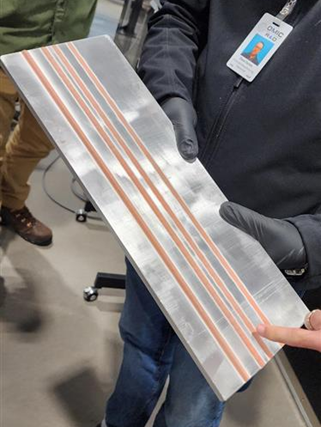
The research team at OMIC R&D’s Center of Innovation Excellence saw an opportunity to apply “cold spray” technology to this industry problem. The tool at the center of this work is the Titomic TKF 1000, a modular cold spray additive manufacturing system developed by Titomic, a global leader in cold spray technology with origins in Australia and a growing international presence. Titomic’s proprietary Titomic Kinetic Fusion™ technology is engineered to deliver faster turnaround, superior component strength, and enhanced sustainability across a range of demanding industrial applications. The TKF 1000 brings that capability directly to OMIC’s research floor, supporting everything from prototyping and R&D, to small-run production and on-demand manufacturing, and new industry application development.
Unlike conventional thermal spray or welding approaches, cold spray deposits material at high velocity but without introducing significant heat, thereby preserving the structural integrity of the base component while adding a tough, wear-resistant surface layer. For this project, researchers are using the TKF 1000 to apply nickel-based coatings to dredging teeth, building up a protective surface designed to resist the abrasive forces that cause rapid wear. Coated teeth are then delivered directly to Glacier Northwest for field testing under real operational conditions, putting the research where the wear actually happens.
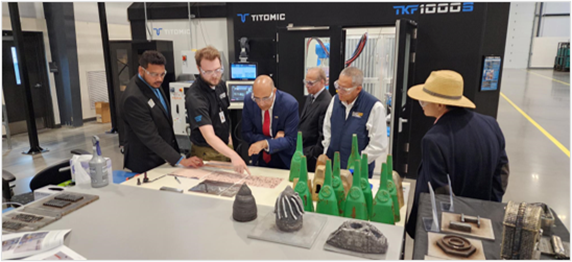
“This is exactly the kind of applied problem we exist to tackle,” said Don Hendrickson, Executive Director of OMIC R&D. “Glacier Northwest has a real operational pain point, and we have the equipment and the expertise to explore meaningful solutions. When research connects directly to a company’s bottom line, that’s when it matters most.”
FFor the researchers doing hands-on work, the project represents a compelling challenge in materials science and surface engineering. “Cold spray gives us a really interesting toolset for this kind of application,” said Trent Lamont, Additive Machine Solutions Researcher at OMIC R&D. “We’re doing a lot more than just laying down a coating — we’re engineering a surface. Finding the right nickel-carbon combination to stand up to that kind of abrasive wear takes careful iteration, but the early results give us a lot of confidence we’re on the right track.”
Associate Researcher Dave Eames echoed that optimism while pointing to the work still ahead. “Every combination we test tells us something. We’re building a real picture of how these coatings behave, and each iteration gets us closer to something that could genuinely change how often Glacier Northwest has to stop and replace these teeth.” The data path and research findings will be available, and valuable, industry-wide.
Dr. Mostafa Saber, Professor and Dean’s Fellow at Oregon Tech, OMIC R&D’s host institution and Oregon’s only polytechnic university brought an additional dimension to the project’s significance. “What we’re doing Glacier Northwest is a direct expression of what applied research looks like when it’s grounded in real industrial need,” said Dr. Saber. “The materials science behind these coatings is genuinely interesting work, and the fact that it has an immediate, tangible application for an Oregon company makes it exactly the kind of research Oregon Tech and OMIC R&D were built to support.”
Powered by Oregon’s Innovation Investment: The Center of Innovation Excellence
This research is made possible (and available to Glacier Northwest at no cost) through OMIC R&D’s designation as one of Oregon’s five Centers of Innovation Excellence (CIE) recognized by Business Oregon, the state’s economic development agency. The CIE program supports public-private partnerships focused on advancing technology commercialization and applied research within targeted industries, with OMIC R&D serving as Oregon’s designated CIE for additive manufacturing.
The CIEs are a cornerstone of Oregon’s 10-Year Innovation Plan, serving as industry-led Innovation Hubs that connect entrepreneurs, researchers, investors, and industry leaders to each other and the resources they need to bring new technologies to market. For OMIC R&D, that designation translates directly into the ability to conduct meaningful industry research, principally for Oregon companies like Glacier Northwest, without placing the financial burden on the companies being served. The goal is straightforward: lower the barrier to entry for Oregon manufacturers exploring what additive technology can do for them. Because Glacier’s primary dredge tooth supplier also is Oregon-based Esco, the Oregon benefit is magnified.
“Over the past nine years Glacier has tried many cutting edge (pun intended) technologies to Improve the wear characteristics and usable life of the dredge’s wear components – including hard-facing the tips and carbide embedding the teeth, to name a couple – but to no avail,” says Wyatt Roseman, Plant Manager at Glacier Northwest. “Leadership at Glacier Northwest is optimistic of this technology, and excited to partner with OMIC on this project.”
Urmaze Naterwalla, Director of Research and Operations, sees the CIE grant as a critical enabler for exactly this kind of work. “The support we receive through Business Oregon’s CIE program is what allows us to say ‘yes’ to companies like CalPortland without asking them to write a check first. That changes the conversation entirely. Instead of talking about cost and feasibility, we can get straight to the science. That’s where the interesting things happen.”
The team is continuing to refine coating material combinations, with the goal of identifying a formulation that significantly extends tooth service life and reduces costly downtime. But the Glacier project is also part of a larger vision: to use the CIE grant as a door-opening that introduces Oregon’s manufacturing community to the full potential of additive technology, demonstrating that cold spray, and the broader family of additive processes available at OMIC R&D, are not just for aerospace or defense, but for the gritty, real-world work that keeps Oregon’s industries running and makes them even more competitive.
“What makes this project a strong example of what the CIE is designed to do is the feedback loop that runs directly through the company we’re serving,” said Naterwalla. “Glacier Northwest takes the coated components into the field, and what they learn there informs what we do next in the lab. That’s the collaborative research model we want to build — and we want every Oregon manufacturer to know that door is open to them.”
OMIC R&D is designated as one of Oregon’s five Centers of Innovation Excellence (CIE) under a statewide initiative funded by the Oregon State Lottery and administered by Business Oregon.”